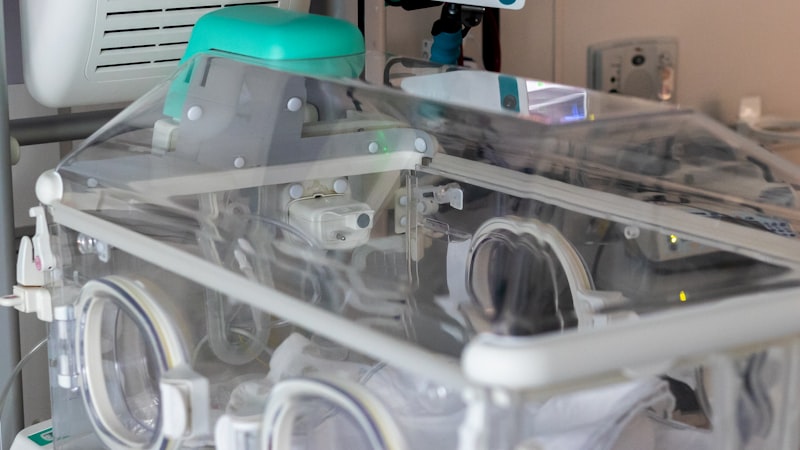
The IV that feeds premature babies in their first hours is about to lose its main supplier — so the FDA is loosening the rules for 180 days
Two compounding facilities that make most of the country's "starter" parenteral nutrition for newborns are shutting down. There is no FDA-approved version to fall back on. On Thursday the agency told hospital pharmacies they can make it themselves, without a patient-specific prescription, for the next 180 days. Here is what that means if your baby lands in a NICU this winter.
A baby born at 28 weeks cannot eat. Not by mouth, not by feeding tube — the gut is not ready. So within the first hours of life, a neonatal intensive care unit hangs a small bag of clear fluid, sugar and protein and sometimes calcium, and runs it into a vein. Clinicians call it starter parenteral nutrition, or starter PN. It buys the team a day or two to build a custom formula for that specific child.
On Thursday the Food and Drug Administration announced that the country's main source of those bags is going away. Two outsourcing facilities — large compounding operations that make sterile drugs in bulk for hospitals — are permanently shutting down, and children's hospitals raised the alarm about what happens to their supply. The FDA's own guidance document is blunter than the press release: the agency has "received reports of potential serious supply disruptions resulting from the market exit of the predominant source" of these products.
The response is a 180-day emergency waiver, in effect immediately, that lets hospital and state-licensed pharmacies compound starter PN for other hospitals without the patient-by-patient prescription the law normally requires. It expires March 8, 2027, unless the FDA extends it.
- September 4, 2026 — the FDA issues immediately-in-effect guidance on compounding starter parenteral nutrition for neonates
- 2 outsourcing facilities permanently shutting down, described by the FDA as the "predominant source" of standardized neonatal starter PN in the US
- 0 — the number of FDA-approved starter parenteral nutrition products for neonates. Every bag is compounded
- 180 days of enforcement flexibility, until March 8, 2027
- 15 eligible formulations, all 250 mL bags: 5% or 10% dextrose, 2% to 3.5% pediatric amino acids, with or without calcium gluconate and 125 units of heparin
- 30 hours at room temperature or 9 days refrigerated — the default shelf life outsourcing facilities may assign before a stability study is complete
- 10.41% of US births in 2025 were preterm, per CDC provisional data; 9.8% of all newborns were admitted to a NICU in 2023
(Sources: FDA press announcement, September 4, 2026; FDA, Temporary Policies for Compounding Certain Starter Parenteral Nutrition Drug Products for Neonates, September 2026; CDC/NCHS provisional 2025 births; NCHS Data Brief 525.)
Why a product this important has no approved version
The odd fact at the center of this story is buried in the FDA's guidance: "at this time there are no FDA-approved starter parenteral nutrition drug products for neonates." None. The bags hanging in every NICU in America are compounded — mixed by a pharmacy rather than manufactured under an approved application.
That is not because anyone is cutting corners. Parenteral nutrition has always been compounded, because it is a recipe adjusted to the patient. What changed over the past decade is that a handful of outsourcing facilities — a category Congress created in 2013 after a contaminated-steroid outbreak that the CDC says killed 64 people — began making standardized starter bags in bulk, so hospitals did not have to mix them at 3 a.m. The market is small, the margins are thin, and it consolidated the way small markets do. Now two of the players are leaving and the FDA is describing them, together, as "the predominant source."
The agency is careful to say compounded drugs "can also pose a higher risk to patients than FDA-approved drug products," because they are not reviewed for safety or effectiveness before use. Which makes the situation a little absurd: the FDA is recommending approved products whenever possible for a product that has no approved version, while relaxing the rules on the compounded version because the compounded version is running out.
What the waiver actually lets pharmacies do
Two sets of rules are being relaxed, for two kinds of pharmacies.
Hospital and state-licensed pharmacies — the ones regulated under section 503A of the federal drug law — normally may compound only for a named patient with a prescription. Until March 8, 2027, the FDA says it will not take action against a pharmacy that makes starter PN and ships it to a hospital in advance, no patient name attached, as long as the bag matches one of 15 formulations in the guidance, carries a conservative use-by date, is single-use with no preservatives, and the state pharmacy board has been told and does not object. The FDA also expects the hospital to keep records of which baby got which bag, so a bad batch can be traced.
Outsourcing facilities — the 503B operations that remain — get a different break. They may use bulk ingredients not otherwise on the FDA's permitted list, and they may skip the full stability study normally required before assigning an expiration date, using a default of 30 hours at room temperature or nine days refrigerated instead. Once a facility expects to pass 5,000 units of a product, it has to start the stability testing.
"The FDA is committed to deploying every regulatory tool available to prevent critical supply chain gaps from threatening patient care," said Acting Commissioner Kyle Diamantas. Michael Davis, the acting head of the agency's drug center, added that the policies are "intended to help hospitals maintain access to this life-saving nutrition during this transition."
Transition to what, the guidance does not say. The FDA says it is "working with industry and alternative suppliers to increase supply" and may extend the waiver. There is no approved product in the pipeline mentioned anywhere.
Who this touches
More families than the phrase "premature babies" suggests. The CDC's provisional count puts the 2025 preterm birth rate at 10.41%, unchanged from 2024 — roughly one birth in ten. And NICU admissions have been climbing: 9.8% of all newborns in 2023, up 13% since 2016, according to the National Center for Health Statistics. Not every NICU baby needs starter PN, but the ones born earliest and sickest almost always do, and they need it in the first hours, not after a pharmacy finishes a custom order.
It also touches the hospital bill, though not in the way you can fight. Starter PN is bundled into the NICU's daily charge; you will not see a line item for it, and the shortage will not show up on your explanation of benefits. What can show up is the cost of a baby transferred to another hospital because the first one ran short — an ambulance, a second facility, a second network. That is the scenario the FDA is trying to prevent, and it is the one worth asking about.
If you are expecting a baby who may need the NICU
You cannot stockpile IV nutrition and you should not try to become an expert in amino acid concentrations. But a few questions are fair to ask, and a good unit will not mind.
Ask the hospital where its starter PN comes from now, and what the plan is for October. A NICU that has already lined up an outsourcing facility or its own pharmacy under the new guidance will say so. One that has not heard about the shortage is telling you something too.
Ask whether the unit compounds in-house. Under the waiver, a hospital pharmacy can make these bags itself. That is not worse care — it is how it was done for decades — but it is worth knowing the pharmacy is set up for sterile neonatal compounding.
If a transfer is discussed, ask why and ask about network. A transfer for clinical reasons is a medical decision. A transfer because of supply is a logistics decision, and it is reasonable to ask whether the receiving hospital is in your plan's network before the ambulance leaves. Federal law limits what you can be charged for emergency care and for out-of-network providers at an in-network hospital; our No Surprises Act guide explains what is protected and what is not, and the ambulance guide covers the gap the law left open.
Keep the paperwork. The FDA expects hospitals to record which compounded product each baby received. If there is ever a recall or a quality problem, that record is what connects your child to the batch. It is fair to ask that it be in the chart. Our guide to getting your medical records covers how to request it later.
The part that should bother you
This is the second time in two years the FDA has had to issue emergency compounding flexibility for IV products — the first came in October 2024, after a hurricane flooded the plant that made most of the country's IV fluids. The lesson both times is the same. The least glamorous products in medicine, the bags of sugar water and salt water that everything else depends on, are made by a very small number of facilities for very little money, and nobody notices until one of them closes.
The FDA moved fast this week, and the waiver is sensible. But a 180-day enforcement memo is not a supply chain. Somewhere between now and March 8, someone has to decide that feeding premature babies in their first hours of life is a business worth being in. This week, two companies decided it was not.