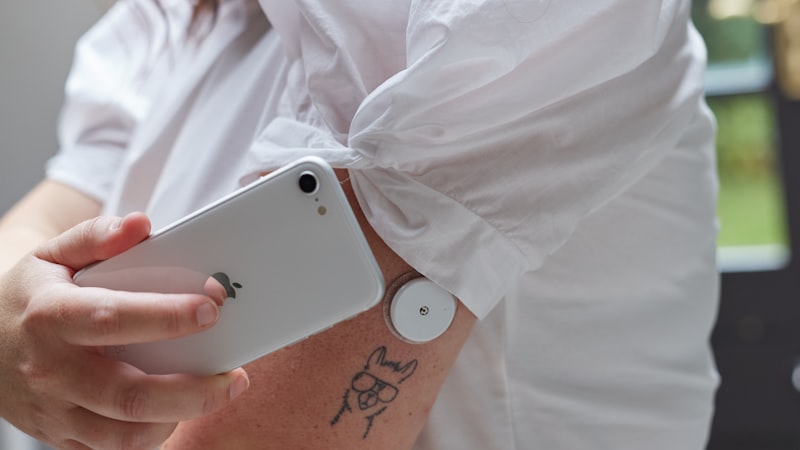
The FDA just cleared a sensor that watches for diabetic ketoacidosis around the clock — the next fight is whether your plan will pay for it
Abbott's Libre Duo is the first wearable to measure ketones and glucose together, every minute, for ten days. For 2.1 million Americans with type 1 diabetes, that turns a finger-prick emergency test into an early-warning system. Coverage will decide who gets it.
Diabetic ketoacidosis is the complication people with type 1 diabetes are taught to fear on day one. When the body runs out of usable insulin, it burns fat instead, ketones build up in the blood, and within hours a manageable situation becomes an ICU admission. It causes roughly 200,000 US hospital stays a year, and the warning signs — thirst, nausea, fruity breath — arrive late and look like a stomach bug.
Until last week, the only way to check was a one-time test: a urine strip or a finger-prick meter that tells you a number but not a direction. The FDA has now authorized the Libre Duo 10 Day, a sensor worn on the arm that measures ketones and glucose in the fluid under the skin every minute, sends both to your phone, shows whether each is rising or falling, and alerts you before ketones cross a dangerous line. The agency's device chief called it "the difference between early intervention and a life-threatening emergency."
- 40.1 million — Americans living with diabetes; 2.1 million with type 1, the group at highest DKA risk
- Every minute, 10 days — continuous ketone and glucose readings from one sensor, ages 2 and up
- 600+ — participants across six clinical studies used for authorization; the sensor flagged rising ketones before DKA developed
- De Novo — the pathway used, meaning this is a new device category with its own special controls
- Insulin-pump users and people on SGLT2 drugs face elevated DKA risk and are obvious first candidates
(Sources: FDA press announcement, CDC, Abbott, American Diabetes Association)
Who this is really for
Everyone with type 1 diabetes can develop DKA, but two groups live closer to the edge. People on insulin pumps depend on a cannula that can kink or fall out silently; with no long-acting insulin on board, ketones can rise within hours. And a growing number of adults take SGLT2 inhibitors — drugs originally for type 2 that some type 1 patients use off-label — which can cause a form of DKA where blood sugar looks normal. A glucose monitor alone misses that entirely. A ketone monitor catches it.
Children are the other group. The FDA cleared the device down to age 2, and parents of young kids with type 1 will recognize the value immediately: a 3 a.m. alert that ketones are climbing is the difference between correcting with insulin at home and driving to the ER.
What it does not do
It does not replace judgment. The FDA's language is specific: ketone readings "should always be interpreted in the context of glucose readings and symptoms." It does not treat anything, and it is not a closed-loop system — it will tell you ketones are rising; you still have to act. And a continuous sensor generates continuous data, which for some patients means continuous anxiety. Diabetes educators have spent a decade helping people set sane alert thresholds on glucose monitors. The same work starts now for ketones.
The price and the coverage question
Abbott has not published a price. The Libre 3 glucose sensor it is built on runs about $75 to $100 per 14-day sensor at cash prices, and a dual sensor will land higher. The bigger issue is coverage. Continuous glucose monitors took years to move from "durable medical equipment with prior authorization" to routine pharmacy benefit for people on insulin; Medicare only broadened its CGM criteria in 2023. A new device category starts that process over.
Expect three things. First, prior authorization for most commercial plans in year one, with the strongest case for pump users, SGLT2 users, and anyone with a prior DKA admission — if that is you, get the admission into the request. Our guide to prior authorization covers how to build that file. Second, a manufacturer copay program, which is standard for Abbott and Dexcom and often brings the first months near zero. Third, an argument over whether it is a pharmacy benefit or a medical benefit, which changes both your copay and whether it counts toward your deductible. Ask that question explicitly; the answer is often not on the summary of benefits.
A note on the bigger trend
This is the FDA's second notable at-home diagnostics authorization in a month, after a robotic blood-draw device in August, and the agency filed both under its "Home as a Health Care Hub" initiative. The direction is clear: more of the testing that used to require a clinic will happen on your arm and your phone. That is good for patients and confusing for benefits departments, which still sort the world into "lab" and "device." Our guide to at-home and direct-to-consumer tests explains how to tell which bucket you are in and what each one costs.
For the family that has done the 3 a.m. ER run, none of that will feel like the point. The point is a sensor that says "rising" while there is still time to do something about it.